How Can You Monitor House Construction in Islamabad From Abroad?
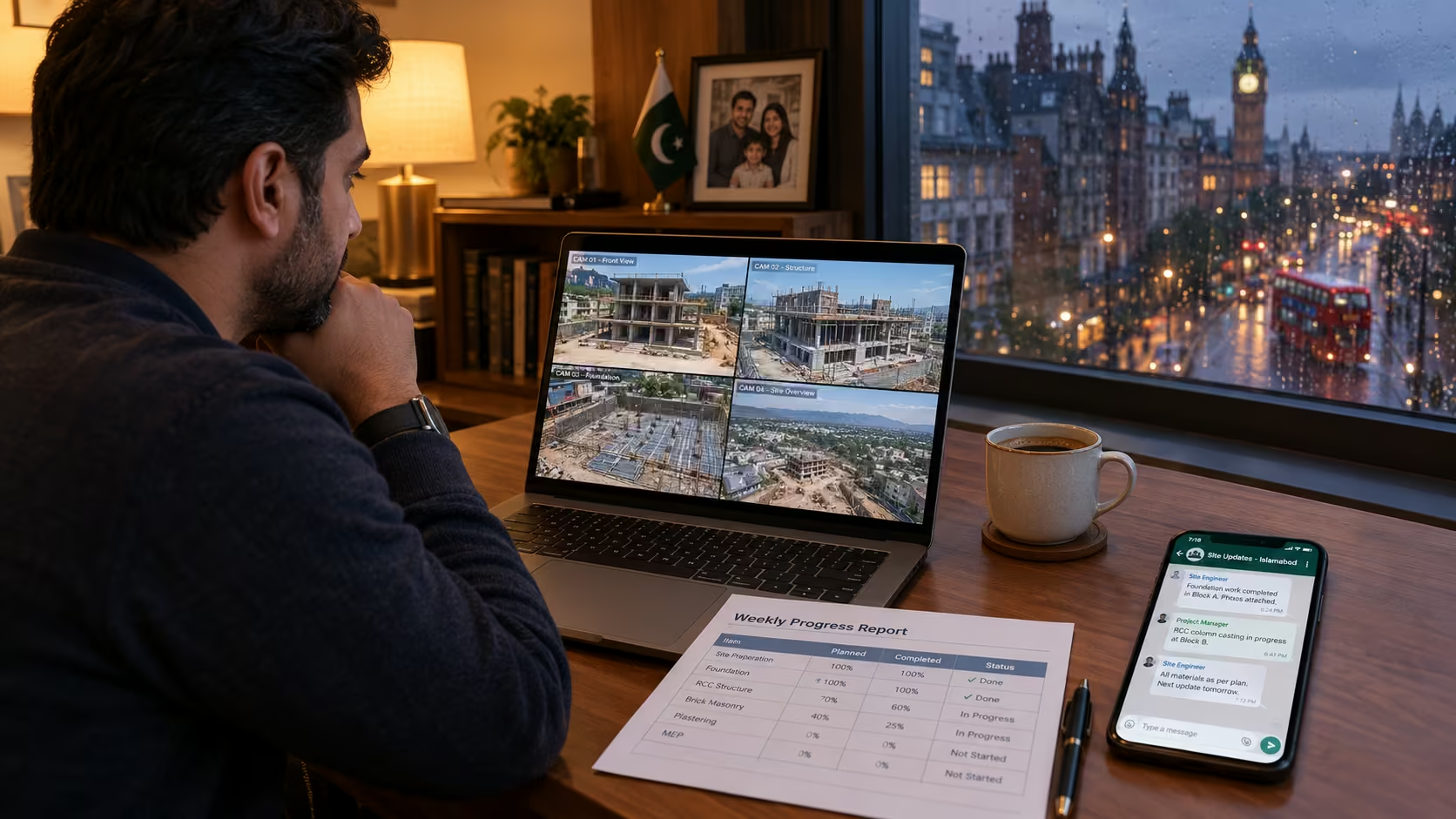
You can monitor house construction in Islamabad from abroad by setting up weekly progress reports, checking work against approved drawings, verifying materials, arranging independent site inspections, and releasing payments against agreed milestones. A clear reporting system helps overseas Pakistanis stay informed without relying entirely on phone calls or occasional site visits.
Building a house in Pakistan while living in the UK, UAE, Saudi Arabia, the USA, or another country can be challenging. You may not be available to visit the site, inspect material deliveries, or resolve construction questions in person.
The solution is to establish a documented monitoring process before construction begins. You should be able to see what has been completed, which inspections have taken place, what has been spent,t and which decisions require your approval.
This guide explains how to monitor house construction remotely, use a practical reporting checklist, and identify issues before they become more expensive to resolve.
Prepare Your Construction Documents Before Work Starts
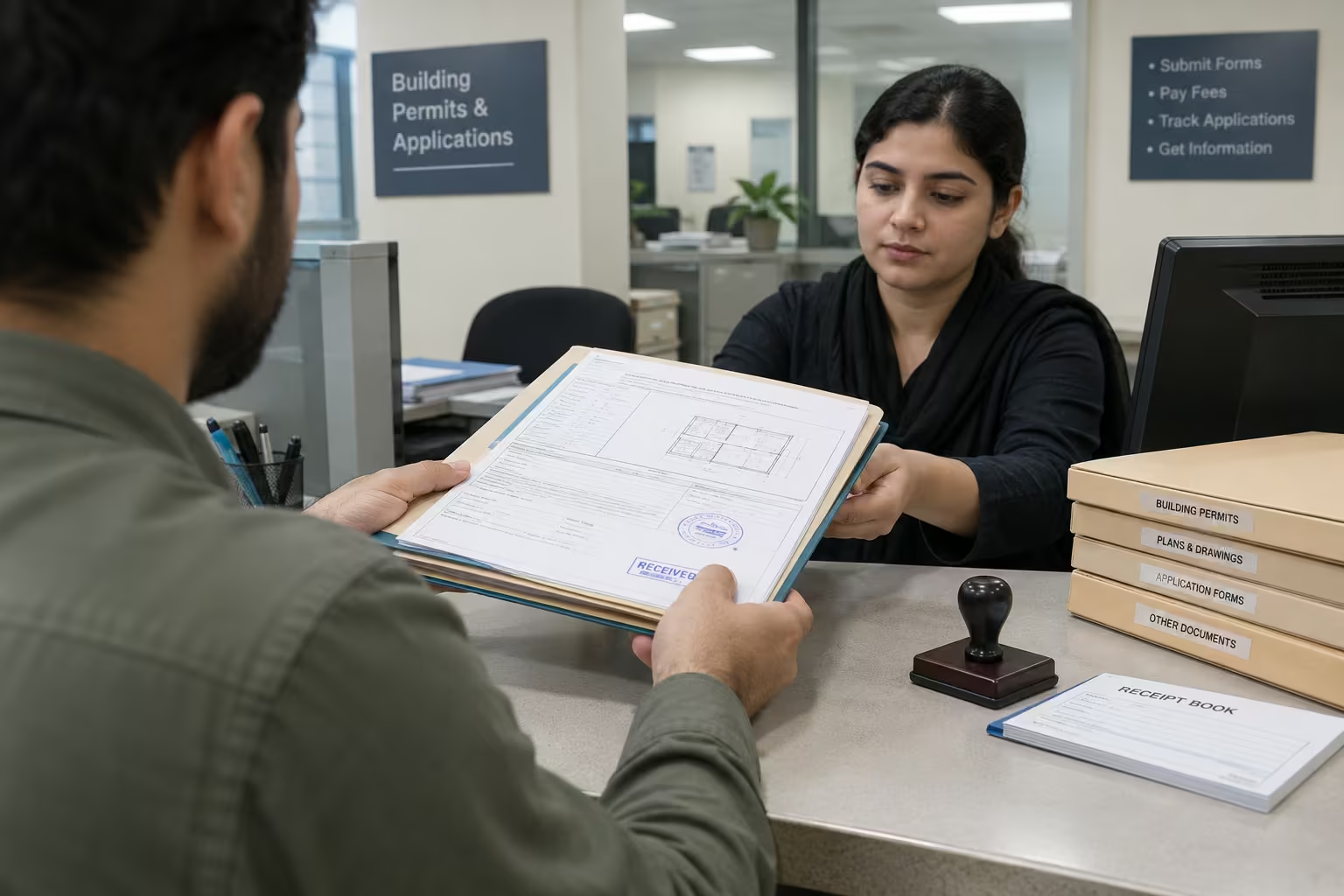
Remote construction management starts with clear documentation. If the drawings, specifications, and responsibilities are unclear, it becomes difficult to verify progress from another country.
Before construction begins, organise these documents:
- Architectural drawings and relevant structural drawings.
- A written scope of work defining what the contractor will deliver.
- A Bill of Quantities (BOQ), where applicable, showing specified quantities and materials.
- Material specifications, including relevant sizes, grades, and approved products.
- A construction schedule with planned milestones.
- A written payment schedule.
- A process for approving additional work and changes.
- Relevant building-plan approvals and other required documents.
Store the latest approved versions in a shared digital folder. Label each document with its date or version number to reduce the risk of the site team using outdated drawings.
A BOQ can help you compare specified quantities with reported work, but it does not independently verify workmanship or material quality. Those require appropriate checks and, where necessary, inspections by qualified professionals.
For more detail, read OKK Construction’s BOQ guide for house construction in Islamabad.
Set Up a Weekly Construction Progress Report
A weekly construction progress report gives you a consistent way to assess what is happening on site. Instead of receiving a general message saying that work is continuing, ask for specific information and supporting evidence.
| Report section | Information to request |
| Work completed | Activities finished during the reporting period |
| Work in progress | Current activities and their completion status |
| Site evidence | Dated photos and a short video walkthrough |
| Material updates | Materials received, used, or awaiting approval |
| Inspection records | Relevant inspection notes and test results |
| Schedule | Planned versus actual progress and delays |
| Budget | Payments made, recorded expenses, and upcoming costs |
| Issues | Problems, proposed solutions, and expected impact |
| Owner decisions | Questions requiring your approval and the deadline |
Ask the responsible project manager or site supervisor to send this report on the same day each week. If an important issue arises, request an immediate update rather than waiting for the next report.
The report should distinguish between completed work and work that is still in progress. Photos should identify the relevant location and stage, not just selected finished areas.
Sample Weekly Construction Report
You can ask your construction team to use the following format:
| Field | Example entry |
| Reporting dates | Week ending: |
| Planned activities | Foundation work and material delivery |
| Completed activities | List the work actually completed |
| Evidence | Links to dated photos and videos |
| Inspection status | Completed, pending, or not applicable |
| Material status | Received, checked, pending approval |
| Delays or risks | Issue, cause, and proposed response |
| Budget update | Approved payments and outstanding amounts |
| Owner approval needed | Decision required and response deadline |
| Next week’s plan | Activities planned for the next reporting period |
The entries above are examples of report fields, not claims about a real OKK project. Your site team should complete the report with actual project information.
Use Video Calls Without Depending on Them Alone
Video calls and site cameras can help you observe progress, discuss changes, and communicate with the construction team across different time zones.
However, a video cannot reliably confirm every technical detail. A camera may show workers pouring concrete, for example, but it cannot independently establish that reinforcement placement or concrete quality meets the relevant specifications.
Use each method for a clear purpose:
- Weekly video calls: Review completed work, upcoming activities, and decisions.
- Recorded walkthroughs: Revisit site conditions when your time zone makes live calls difficult.
- Site cameras: Observe general activity where installation is practical and permitted.
- Inspection reports: Record findings from the relevant qualified professional.
- Shared documents: Maintain a single record of drawings, approvals, reports and payments.
Agree in advance who will provide updates and how quickly urgent questions should be answered. Limit access to project files and camera feeds to authorised people, and consider site security and privacy before installing monitoring equipment.
Arrange Inspections at Critical Construction Stages
Some construction work becomes difficult to inspect after it is covered by the next stage. Plan inspections before important work is concealed, rather than waiting until the building looks complete.
| Construction stage | What to verify | Evidence to request |
| Excavation and foundations | Work against approved plans and relevant site requirements | Dated photos and inspection notes |
| Steel reinforcement | Required bar sizes, spacing and placement against structural drawings | Close-up photos and professional inspection record |
| Concrete work | Specified requirements, placement process and applicable quality checks | Pour records and relevant test results |
| Brickwork and structure | Alignment, dimensions and compliance with drawings | Photos and inspection notes |
| Electrical and plumbing | Routing, locations and required checks before concealment | Photos, marked-up drawings and test records |
| Waterproofing | Specified system, application and required testing | Product details and applicable test records |
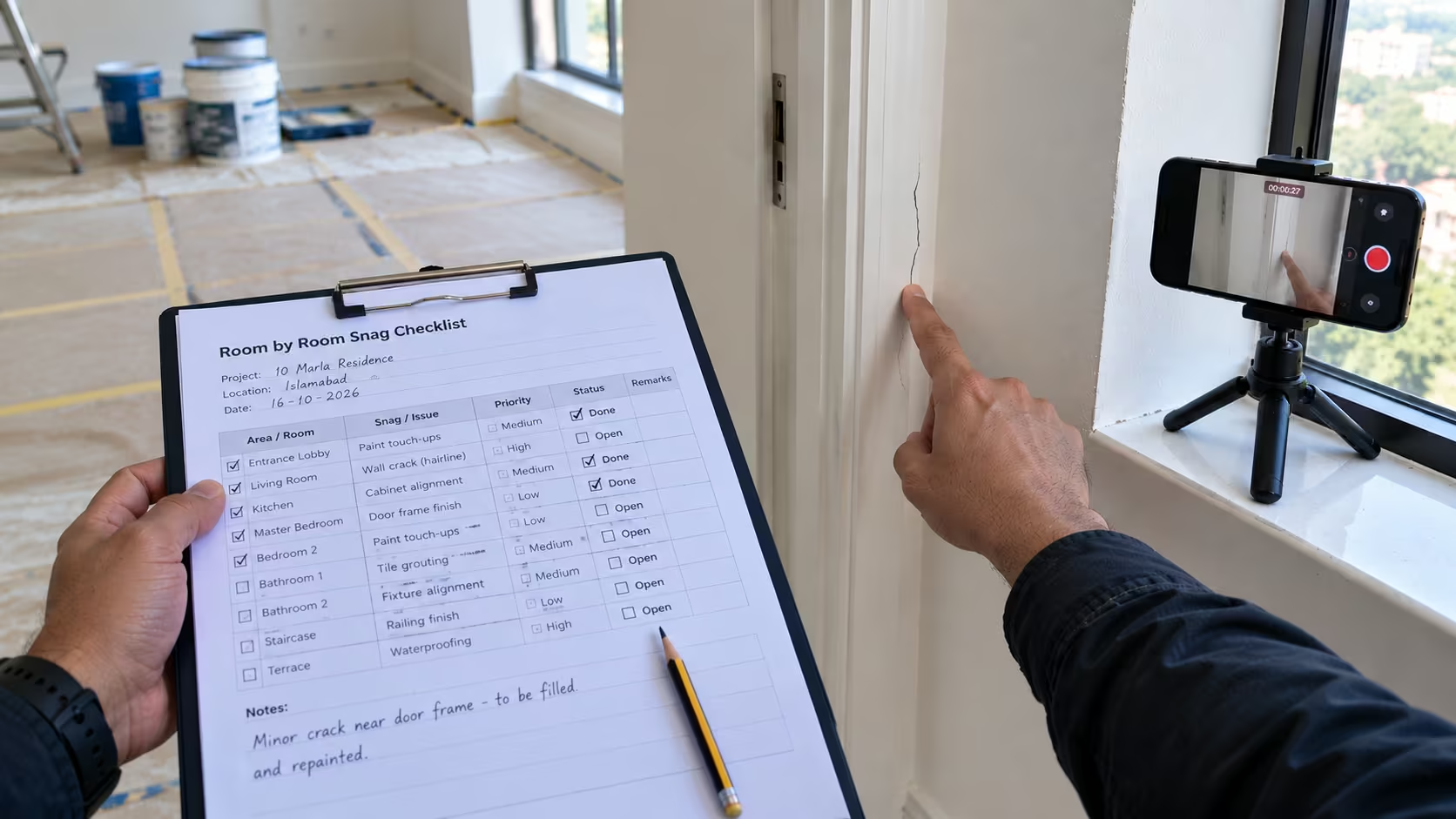
| Finishing | Agreed finishes, fixtures and visible defects | Room-by-room checklist and photos |
| Final handover | Outstanding defects, agreed work and available documentation | Snag list and completion records |
The appropriate checks depend on the design, structural system, specifications and applicable requirements. Ask the responsible engineer or qualified professional to identify the inspections and tests needed for your project.
Do not treat photographs as a substitute for technical inspection when the work requires one. If you cannot attend, arrange for an appropriate local professional to inspect the relevant stage and provide a written record.
Follow a Payment Approval Workflow
Payment control is one of the most important parts of remote construction monitoring. Avoid approving a payment solely because someone says that a stage is complete.
Before construction begins, agree on the payment milestones, required evidence, and approval process in writing.
Use this workflow for each milestone:
- Completion claim: The contractor or project manager reports that the agreed work is complete.
- Document review: Compare the reported work with the scope, schedule, and relevant BOQ.
- Evidence check: Review dated photos, measurements, and applicable inspection records.
- Technical verification: Obtain a suitable professional inspection where required.
- Written approval: Record your approval or list the outstanding issues.
- Payment and record: Make the payment according to the contract and save the receipt.
- Updated balance: Record the payment, remaining amount and any approved variations.
The amount payable may depend on contract terms, verified quantities, quality requirements, agreed deductions and approved changes. Do not assume that a photo alone establishes the value of completed work.
Keep a separate record of the original contract amount, approved variations, payments made and outstanding commitments. If a payment request differs from the agreed milestone, ask for a written explanation before proceeding.
For more information about contract structures, read OKK Construction’s guide to fixed-price versus cost-plus construction contracts in Pakistan.
Approve Materials Before Purchase and Delivery
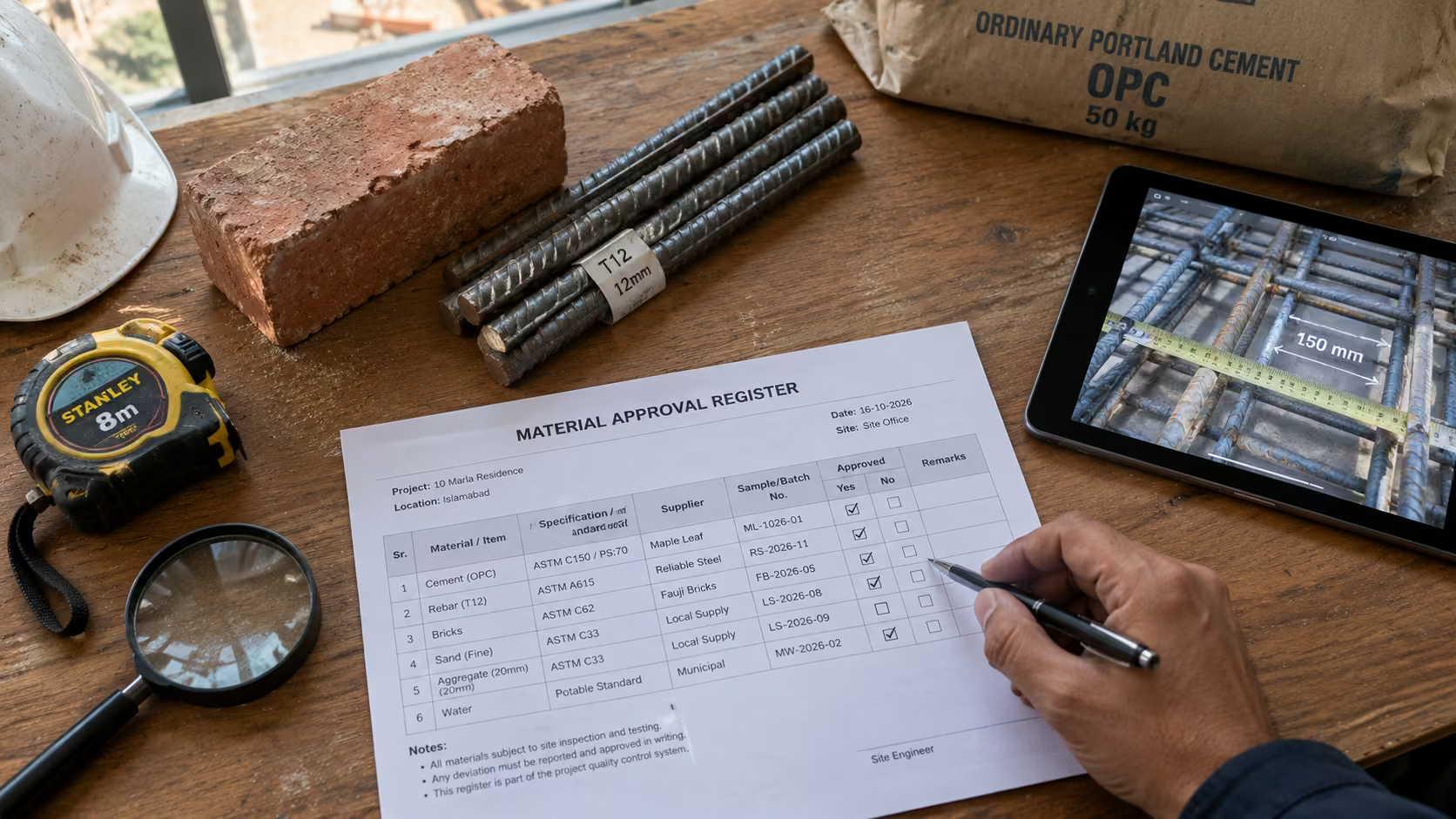
Material substitutions can create disagreements when the owner is abroad. To reduce confusion, maintain a material approval register that identifies the specified product, quantity, supplier, and person responsible for checking delivery.
| Material or item | What to check |
| Cement | Specified product, supplier records and suitable storage |
| Steel reinforcement | Required grade, size, quantity and relevant documentation |
| Bricks or blocks | Agreed type, dimensions and acceptable quality |
| Electrical products | Approved product, ratings and specifications |
| Plumbing materials | Pipe type, sizes, fittings and approved system |
| Tiles and sanitary fittings | Exact model, dimensions, finish and quantity |
| Paint | Product range, finish and agreed colour |
| Doors and windows | Dimensions, material, finish and hardware |
Request product labels, delivery records, invoices or sample photographs where relevant. For products with multiple versions, approve the exact model or sample in writing.
If a specified product is unavailable, ask the team to explain the alternative and any cost or schedule impact. Record your approval before the substitute is ordered or installed.
Monitor the Schedule and Record Delays
A construction schedule should show planned dates, actual progress, upcoming work, and delays. Ask the responsible project manager to update it weekly.
Common causes of delays include material availability, weather, changes to drawings, approval issues, labour availability, and rework. The report should explain the cause and identify which upcoming activities may be affected.
When a delay occurs, ask:
- What caused it?
- Which activities or milestones will it affect?
- What is the proposed recovery plan?
- Will the change affect cost, quality, or the agreed completion date?
Do not accept a revised completion date without understanding the reason behind it. The timeline should reflect your property’s size, design complexity, approvals, resources, and site conditions.
For further planning guidance, read OKK Construction’s house construction timeline guide for Islamabad.
Keep Changes and Decisions in Writing
Phone calls and informal messages can lead to misunderstandings if important decisions are not documented.
Use one agreed communication channel for regular updates. A dedicated WhatsApp group can help with day-to-day communication, but major financial decisions, changes to scope, and formal approvals should also be recorded in the project’s documentation.
For every proposed change, record:
- What will change and why.
- The additional cost or saving.
- The impact on the schedule.
- Any effect on drawings, specifications, or approvals.
- Who approved the change and when.
If a change requires revised drawings or further approval, ask the responsible professional to confirm the requirements before work proceeds.
Check Islamabad’s Applicable Building Requirements
Before construction begins, verify which authority governs your plot and what approvals apply to the property.
Some properties fall under the Capital Development Authority (CDA), while certain housing societies and other developments have their own relevant approval processes. Requirements depend on the property’s location and applicable regulations, so do not assume every Islamabad property follows the same process.
Confirm the relevant building-plan approval, approved drawings, construction conditions, and any required inspection or completion documents. You can consult the CDA’s official laws and regulations page for relevant information.
Keep copies of approvals in the shared project folder. If the design changes, ask whether revised drawings or additional approval may be required.
When selecting a construction company or technical consultant, review relevant experience, written responsibilities, references, and applicable credentials. Where appropriate, check the firm’s registration through the Pakistan Engineering Council’s constructor/operator verification portal.
Registration is one part of due diligence; it does not by itself guarantee workmanship or project performance.
Use a Remote Monitoring Checklist
Use this checklist at the start of the project and review it regularly.
- Latest approved drawings and specifications are stored in one shared folder.
- Scope of work, BOQ, and payment milestones are documented.
- A named person is responsible for weekly progress reports.
- Reports include dated photographs and clear progress updates.
- Required technical inspections are scheduled before work is concealed.
- Materials are checked against agreed specifications.
- Payments are reviewed against contract milestones and supporting evidence.
- Delays, risks and additional costs are recorded in writing.
- Changes require the agreed approval before implementation.
- Applicable building approvals and relevant documents are available.
- Final inspection, snag list and handover documents are planned.
If several items remain incomplete, clarify responsibilities with the project team before assuming that remote monitoring is working effectively.
Recognise Warning Signs Early
A single missed update does not automatically indicate a problem, but repeated inconsistencies deserve attention.
Watch for these warning signs:
- Progress reports stop arriving without explanation.
- The team avoids showing specific areas of the site.
- Materials cannot be matched with the agreed specifications.
- Payment requests lack a clear breakdown or supporting evidence.
- Work appears inconsistent with approved drawings.
- Additional costs appear without written approval.
- Completion dates change repeatedly without a practical explanation.
- Different people give conflicting updates.
- Required inspection records are unavailable.
Request the missing information in writing and compare the response with your contract and existing records. If the concern involves structural safety, concealed work, substantial payments, or a possible contractual breach, consider an appropriate independent review before making the next decision.
Prepare for Final Handover
Before accepting the completed house, arrange a systematic inspection. Where practical, have a qualified professional review the property and document defects.
Check doors and windows, finishes, plumbing, electrical fittings, drainage, visible leakage, agreed fixtures and outstanding work. Confirm the availability of relevant warranties, manuals, test records, approvals and completion documents.
Record each defect in a snag list with its location, responsible party, and agreed correction date. Reconcile the final account and follow the contract’s process for outstanding items.
How OKK Construction Can Help
For overseas Pakistanis, a construction project is easier to manage when responsibilities, reporting, approvals,nd payments are clearly organised.
OKK Construction provides residential and commercial construction services in Islamabad and surrounding areas. If you are planning to build while living abroad, discuss your project scope, drawings, reporting expectations, site supervision, and payment milestones with the team before proceeding.
Ask who will provide site updates, who will be responsible for technical supervision, how material approvals will be recorded a,nd how changes will be authorised.
Explore OKK Construction’s services or contact the team to discuss your requirements.
Planning to build a house in Islamabad while living abroad? Contact OKK Construction to discuss your project and the reporting process that can help you stay informed.
Frequently Asked Questions
How can I monitor house construction in Islamabad from abroad?
Use scheduled progress reports, dated site photos, shared documents, milestone-based payments an, and planned inspections. A qualified local professional can verify technical work that cannot be assessed remotely.
Can I build a house in Pakistan without visiting the site regularly?
A project may be managed with limited visits when responsibilities, communication, documentation,nd inspections are organised properly. Remote monitoring does not remove the need for appropriate technical supervision.
How often should I receive construction updates?
A weekly report is a practical starting point for many projects. Additional updates or inspections may be necessary during critical construction stages, major deliveries, or when an urgent issue arises.
Should I release a payment based only on photos?
No. Review the agreed milestone, supporting documents, quantities, and applicable inspection records. Follow the written contract and obtain professional verification where required.
Can video calls replace a site engineer?
No. Video calls help you observe activity and discuss progress, but they cannot reliably verify every structural detail or concealed service. Use a qualified professional for relevant technical inspections.
How can I control construction costs while living abroad?
Define the scope, prepare suitable quantities and specifications, agree on payment milestones, and document every approved variation. Keep receipts and compare reported progress with payment requests.
Do all properties in Islamabad require CDA approval?
Not necessarily. The applicable authority and requirements depend on the property’s location and governing rules. Confirm the process for your specific plot before construction starts.
What documents should I keep for remote construction monitoring?
Keep current drawings, approvals, scope of work, BOQ, contract, schedule, progress reports, inspection records, material approvals, payment receipts, approved variations, and handover documents.
Final Thoughts
Monitoring house construction in Islamabad from abroad requires a repeatable process, not just occasional updates. Prepare your documents before work begins, review progress every week, arrange inspections at critical stages a,nd approve payments according to the agreed terms.
A well-managed project should make it clear what has been completed, what remains, what it costs, and who is responsible. These steps cannot eliminate every construction risk, but they can help overseas homeowners identify problems earlier and make better-informed decisions.