Finding cracks in the walls of a new house can be alarming, especially when construction has just finished and everything is supposed to look perfect. But not every crack means a house has a structural problem. Some cracks are superficial and develop naturally as plaster, mortar, concrete, and other materials dry and respond to changes in moisture and temperature. Others indicate movement that deserves professional investigation.
The hard part for a homeowner is telling the two apart.
A small hairline crack in a plaster finish is not the same as a widening diagonal crack running through masonry. A crack around a window may have a completely different cause than cracking associated with foundation movement.
So the right question isn’t simply “Is this crack dangerous?” It’s:
Where is the crack? What pattern does it follow, is it changing, and what could be causing the movement?
This guide walks through the common causes of wall cracking, how to recognize patterns that deserve closer attention, what to do before calling a professional, and why filling a crack without understanding its cause can make the problem come back.
This article is general information to help you assess a crack and decide whether to seek professional input. It is not a substitute for an on-site structural assessment, and it does not diagnose your specific situation.
Is It Normal for a New House to Crack?
Yes, to a degree. Buildings are made from multiple materials (concrete, masonry, plaster, wood, steel, tile) that each respond differently to moisture, temperature, and loading. As these materials dry, cure, and settle into place over the first months and years, some minor cracking, particularly fine, stable cracks limited to plaster or finish coats, is a normal part of a building’s early life. It does not automatically mean poor construction.
What is not automatically normal is cracking that is widening, appears in structural elements, runs through masonry rather than just the finish, or is accompanied by other signs of movement (sticking doors, sloping floors, visible displacement). The rest of this guide explains how to tell the difference.
Why Do New Houses Develop Cracks?
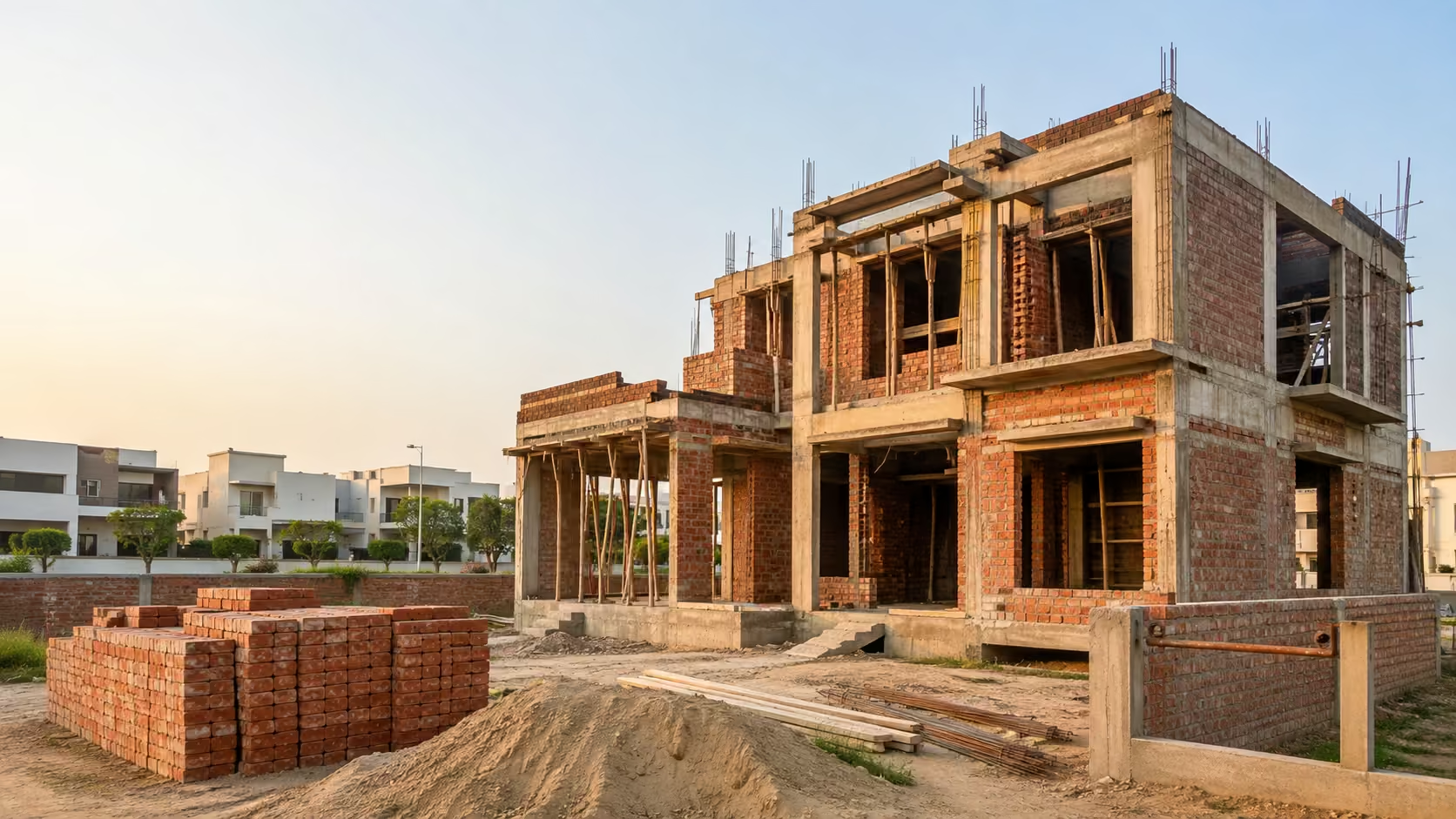
A house is never built from one material. A typical home combines concrete, reinforced concrete, brick masonry, mortar, plaster, steel, tile, wood, glass, and various finishes, and each material responds differently to moisture, temperature, loading, and time.
Cement-based materials, for example, can experience volume changes as their moisture content changes, and temperature swings cause materials to expand and contract. When that movement is restrained by an adjoining material, a fixed connection, or a rigid frame, internal stress can build up and eventually show up as a crack.
Common contributors to cracking in masonry and concrete construction include:
- Moisture-related volume changes (drying shrinkage)
- Temperature-driven expansion and contraction
- Differential movement between different materials
- Foundation or soil settlement
- Structural loading
A crack, in other words, is evidence of movement or stress somewhere in the building,g not automatically a verdict of “harmless” or “dangerous.”
1. Hairline Cracks: Should You Be Worried?
The first crack most homeowners notice is a very thin line on a freshly plastered wall or ceiling.
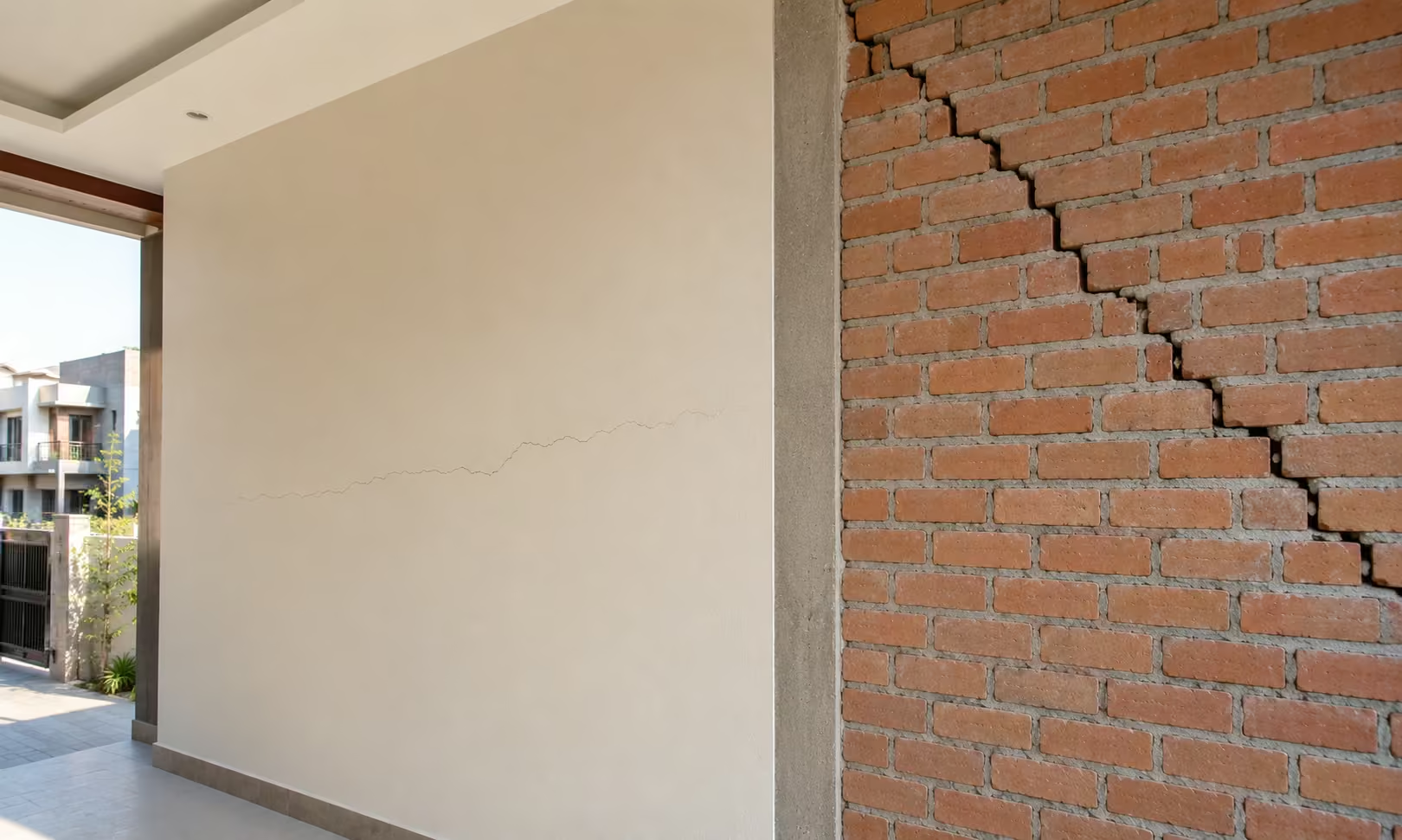
Hairline cracks often come from drying shrinkage in plaster or cement-based finishes, or from minor movement where different materials meet during a building’s early life.
A fine surface crack is generally less concerning when:
- It’s limited to the finish coat (paint or plaster), not the masonry beneath it
- It stays the same size over time
- There’s no visible displacement (nothing offset, raised, or sunken on either side)
- Doors and windows nearby still operate normally
- There’s no associated moisture or dampness
But a hairline appearance alone doesn’t prove a crack is harmless; location and behavior matter as much as width. If a hairline crack keeps widening, reappears in connected areas, or shows up alongside other signs of movement, it’s worth a closer look.
2. Shrinkage Cracks in Plaster and Masonry
Drying shrinkage is one of the most common reasons cement-based construction cracks. As moisture leaves the material, it shrinks slightly; if that shrinkage is restrained, tensile stress builds up and can crack the surface.
This is why “properly built” doesn’t mean “zero cracks forever.” The realistic goal in construction is crack control, managing predictable movement so cracking stays minor and cosmetic, not eliminating cracking altogether. Good detailing, appropriate reinforcement, movement joints where needed, compatible materials, and proper curing all help control this kind of cracking.
For a homeowner, the practical takeaway is that a small shrinkage crack in plaster calls for a very different response than a crack caused by ongoing foundation movement, and confusing the two leads to the wrong fix.
3. Cracks Where Different Materials Meet
Pay close attention to places where two different materials meet, such as:
- Brickwork and concrete
- Masonry and reinforced-concrete columns
- Wall-and-slab junctions
- Plaster and other finishes
- Door and window frames
- New extensions connected to an existing structure
Different materials rarely expand, contract, or respond to moisture at the same rate, and that mismatch, differential movement, is a well-known source of cracking at material junctions.
A crack at a material junction isn’t automatically an emergency, but its exact location is a useful diagnostic clue, which is why experienced construction teams pay close attention to these junctions during design and build rather than waiting for cracks to appear.
4. Cracks Around Doors and Windows
Openings interrupt an otherwise continuous wall, and stress tends to concentrate around them, which is why cracking near doors and windows is so common.
Watch for cracks that appear:
- Above a door or window
- From the corner of an opening
- Along the side of an opening
- Around the lintel
- At the junction between the frame and the surrounding masonry
A small plaster crack around an opening may well be superficial. But if it’s widening, extends into the masonry, shows displacement, or coincides with a door or window that’s suddenly hard to open or close, it deserves a closer look. The pattern and progression tell you more than the crack’s mere presence near an opening.
5. What Does a Stair-Step Crack Mean?
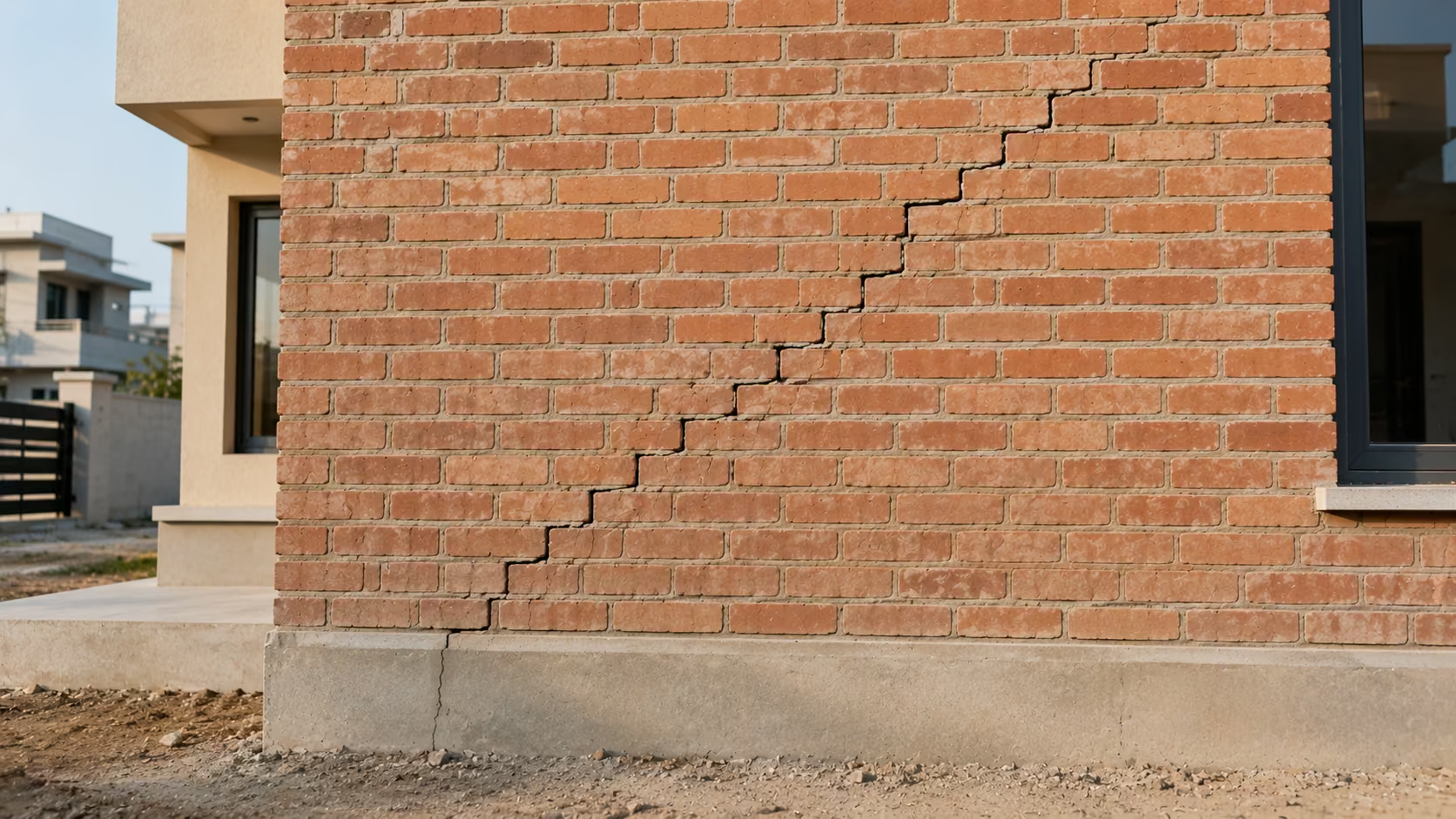
A stair-step crack follows the mortar joints of brick or block masonry in a zig-zag pattern. This pattern can be associated with differential settlement, where different parts of the foundation or supporting ground move by different amounts,s but a stair-step crack by itself doesn’t prove the foundation is failing.
A proper assessment looks at more than the pattern alone:
- Crack location and direction
- Crack width and whether it’s increasing
- Foundation and soil conditions
- Whether similar cracks appear elsewhere in the building
- Whether doors or windows are changing
- Whether floors or walls show visible displacement
If differential settlement is suspected, simply filling the visible crack is not a diagnosis; it treats the symptom while the underlying movement, if any, continues.
6. Vertical, Horizontal, and Diagonal Cracks
Crack direction is a useful clue, but never a stand-alone diagnosis. The same direction can have very different causes depending on location and context.
Vertical cracks can sometimes relate to shrinkage or minor movement in masonry and finishes; their significance depends on location, width, depth, and whether they’re progressing.
Horizontal cracks have several possible causes, and a horizontal crack limited to plaster is a different situation than one that runs through masonry or a structural element. Horizontal cracking involving a load-bearing wall generally warrants more attention.
Diagonal cracks deserve closer attention, specifically when they’re widening, connected to visible displacement, or running from the corner of an opening toward a foundation-adjacent area. This combination is more often associated with settlement-related movement than with an isolated diagonal line elsewhere on a wall.
The direction of a crack is a clue, not a diagnosis. A professional looks at the complete pattern direction, location, width, and progression together rather than deciding the cause from direction alone.
7. Cracks in Beams, Columns, and Slabs Need More Attention
A crack in a plastered wall and a crack in a concrete column are not the same category of problem, even if they look similar at a glance.
If cracking appears directly in a:
- Reinforced-concrete column
- Beam
- Structural slab
- Foundation component
- Structural wall or major staircase component
It shouldn’t be treated as a simple plaster defect. Reinforced concrete can crack for several reasons: shrinkage, temperature effects, restraint, loading, or construction-related factors,s and while not every visible concrete crack signals structural failure, cracking in a load-bearing element warrants a different, more careful level of assessment than a crack in a finish coat. If you can’t tell whether a crack is limited to the finish or extends into the structural element beneath it, that uncertainty itself is a reason to get a professional opinion rather than guess.
8. Warning Signs of a Structural Wall Crack
There’s no single crack width that works as a universal rule for calling a building unsafe. Instead, look for a combination of the following:
| Sign | What to look for |
| Widening | The crack is measurably larger than it was weeks or months ago |
| Displacement | One side of the crack is offset, pushed outward, higher, or lower than the other |
| Depth | The crack continues through the masonry, not just the paint or plaster |
| Pattern | Several related cracks appear together, rather than one isolated line |
| Doors/windows | Nearby doors or windows have started sticking or misaligning |
| Floors/walls | Floors or walls show unexpected sloping, separation, or distortion |
| Water | Water is entering through the crack |
| Structural involvement | The crack is in a column, beam, slab, or foundation element rather than a finish |
None of these signs alone proves a structural problem, but the more of them that appear together, the stronger the case for a professional assessment.
9. New Construction: Normal Movement or a Defect?
Because this guide focuses on new houses, it’s worth separating two different situations that can look similar:
- Normal early-life movement: minor shrinkage or thermal cracking in plaster or finishes during the first months to a couple of years, as materials dry out and settle. This is common and expected to some degree, even in well-built homes.
- A possible construction or workmanship issue: cracking that appears quickly after handover, is unusually severe, involves structural elements, or is accompanied by other defects (uneven floors, poor-fitting doors/windows, visible foundation issues).
If a crack appears soon after handover and seems disproportionate to normal material movement, it’s reasonable to raise it directly with the builder or contractor and request an inspection, in addition to seeking an independent opinion if the response is unsatisfactory or the issue involves a structural element.
Cosmetic Cracks vs. Potential Structural Warning Signs
| Observation | May be less concerning | Deserves closer attention |
| Location | Paint, plaster, or surface finish | Masonry or structural element |
| Width | Very fine and stable | Clearly widening |
| Pattern | Isolated surface line | Connected or repeated pattern |
| Movement | No visible displacement | Visible separation or offset |
| Progression | Unchanged over time | Continues to develop |
| Doors/windows | Operate normally | New sticking or distortion |
| Moisture | No water penetration | Dampness or water entry |
| Structure | No structural involvement | Beam, column, slab, or foundation affected |
This table isn’t a structural safety test; it’s a way to decide whether the crack in front of you is worth investigating further.
Why Climate and Ground Conditions Matter
Pakistan experiences considerable seasonal temperature variation, and Islamabad and Rawalpindi in particular see a wide swing between winter lows and summer highs. Temperature and moisture movement are well-established contributors to cracking in masonry and concrete construction,n but that doesn’t mean every crack in an Islamabad or Rawalpindi home should automatically be blamed on weather. It simply reinforces why proper material selection, detailing, curing, drainage, and construction workmanship matter in this climate.
Ground conditions matter just as much. Pakistan’s building regulations address site considerations, soil conditions, and foundation design, and in some jurisdictions, a soil investigation report is required before construction, reflecting the general engineering principle that foundation performance depends heavily on what’s actually beneath the building, not just what’s built above ground. If serious cracking is suspected to relate to settlement, the answer often lies below the visible crack rather than in the plaster itself.
Note: Specific building-code provisions and local regulatory requirements vary and are periodically updated. For current requirements applicable to your project, check with your local development authority or a licensed structural engineer rather than relying solely on this article.
What About Homes in Islamabad and Rawalpindi Specifically?
The core principles above apply everywhere, but a few things are worth thinking about specifically in this region:
- Seasonal curing conditions.
Plaster and concrete cure differently in the height of summer heat versus cooler winter months. Rushed curing during hot weather is a common, avoidable contributor to shrinkage cracking.
- Soil variability.
Foundation and soil conditions can vary meaningfully across the Twin Cities depending on the specific site, which is part of why a soil investigation (rather than assuming standard conditions) matters for new construction.
- Monitoring across seasons.
If you’re tracking a crack, note whether it changes with the seasons (widening in summer heat, for example) versus staying constant year-round. Seasonal cracks that stabilize are generally a different situation than cracks that steadily worsen regardless of season.
Why Simply Filling a Crack Can Be a Mistake
The most common homeowner response to a crack is: fill it and paint over it.
Sometimes that’s a perfectly appropriate finishing repair. But if the underlying movement is still happening, filling the surface only hides the symptom, and the crack is likely to return.
General repair guidance for cracking recommends first determining the cause of a crack and whether the associated movement is still occurring before deciding on a permanent repair. A sensible sequence looks like this:
Observe → investigate → identify the cause → address the cause → repair the finish.
The right repair depends entirely on the mechanism behind the cracking. A plaster shrinkage crack may need nothing more than a straightforward finishing treatment. A settlement-related crack may require investigating the foundation or the ground beneath it first. Treating these as the same problem is how a “fixed” crack ends up reappearing a year later.
How to Check a Crack Before Calling a Professional
You don’t need to be an engineer to make useful observations. Here’s a simple process:
-
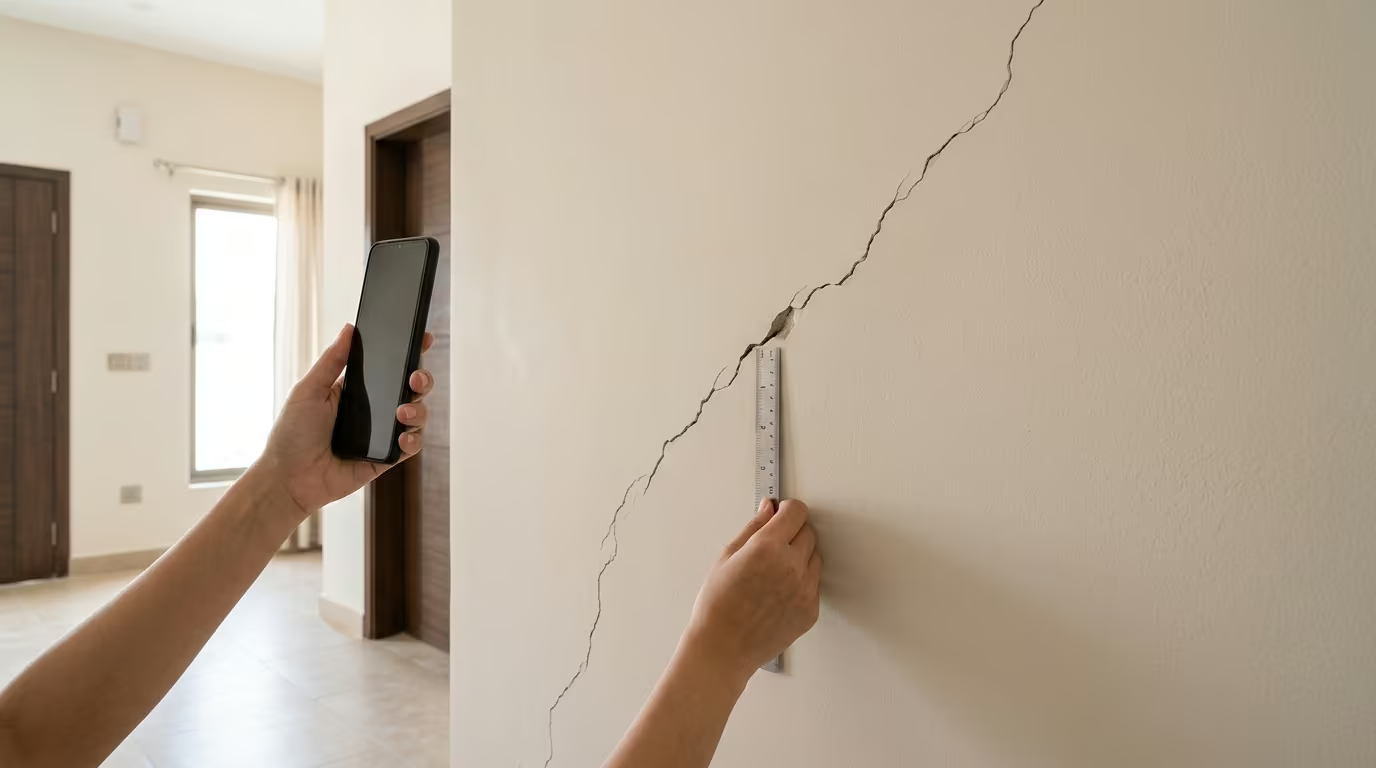
Photograph it.
Take a close-up shot and a wider photo showing where it sits in the room.
-
Record the location.
Note whether it’s internal or external, near a door or window, at a corner, on a ceiling, on a beam or column, near the floor, or near the foundation.
-
Observe the pattern.
Is it vertical, horizontal, diagonal, stair-step, random, or following a material junction?
-
Monitor it over time.
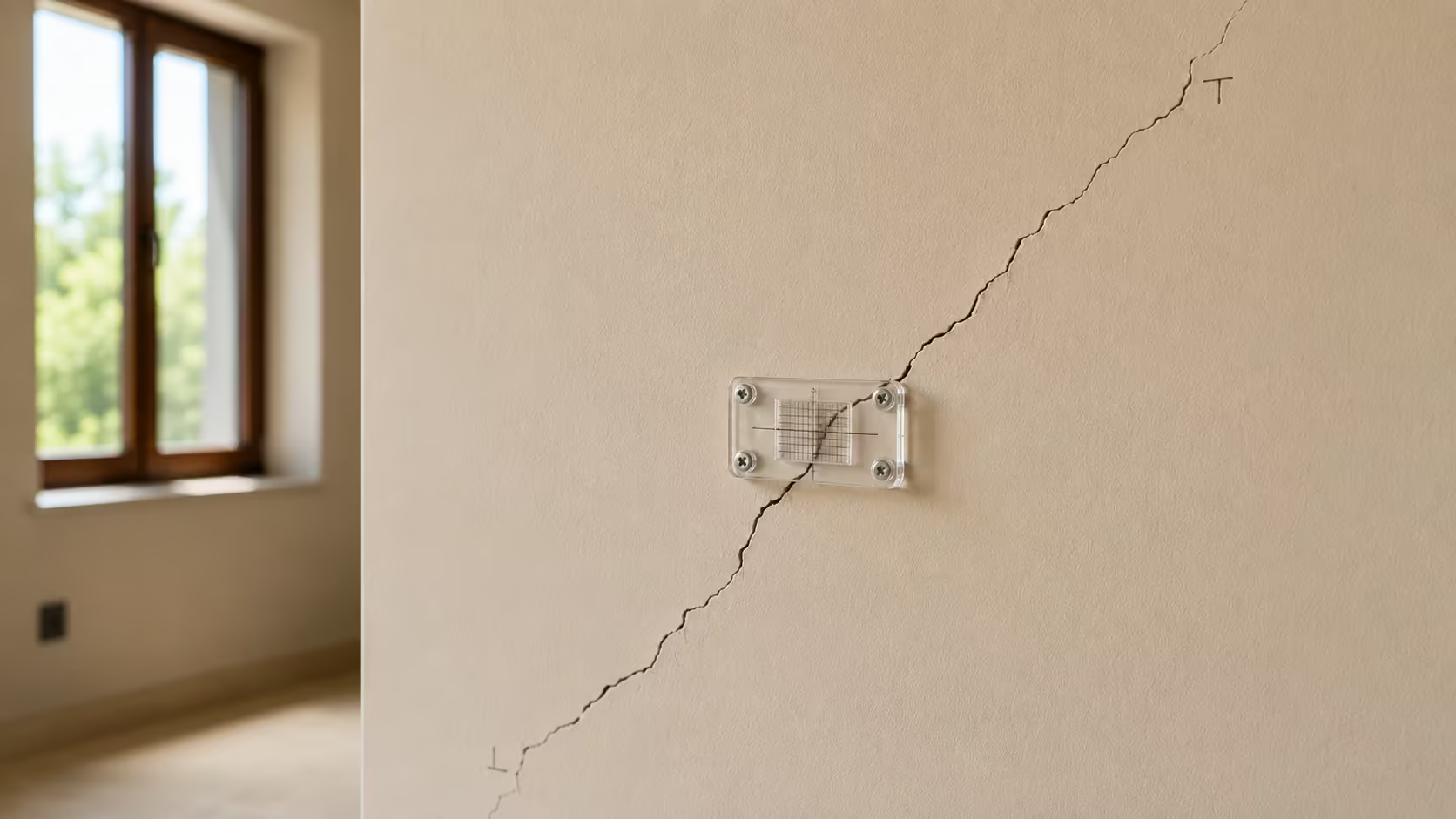
A simple method: mark each end of the crack with a dated pencil line (or use an inexpensive crack-monitoring gauge/tape), and check monthly whether the crack has extended past your marks or widened noticeably. A few months of stable measurements is a meaningfully different situation than a crack that keeps growing.
-
Check the surrounding area.
Look for new cracks nearby, dampness, separation, distorted door/window frames, or uneven floors.
-
Avoid rushing to a cosmetic repair.
If the crack is changing or its cause is unclear, document it before painting over it. Once it’s filled, you lose the ability to observe whether it’s still moving.
What a Construction Professional Looks At
A professional assessment doesn’t stop at “normal” or “dangerous”; it looks at the building as a system:
- Crack geometry
Direction, length, location, and pattern
- Progression
Is it stable, or actively widening
- Material involvement
Limited to plaster, or extending into masonry or concrete
- Structural relationship
proximity to a beam, column, opening, or foundation
- Soil and foundation conditions
Relevant when settlement is suspected
- Moisture
Water penetration can both contribute to cracking and worsen existing defects
- Construction history
When the crack appeared, what work was recently completed nearby
This is why a proper diagnosis should come before choosing a repair method, not after.
Can Good Construction Prevent Cracks Completely?
No, and no one should promise you that. The realistic goal is crack control, not zero cracking. Even well-designed, well-built homes experience some movement because the materials themselves respond to their environment.
What good design and construction can do is reduce avoidable cracking and manage predictable movement, through:
- Proper site and foundation assessment, including understanding the soil the building sits on
- Sound structural design: with loads, members, and connections properly designed for the site
- Correct reinforcement: to help manage tensile stress in concrete and masonry
- Appropriate movement/control joints: where predictable material movement needs to be accommodated
- Material coordination: so materials with different movement characteristics are detailed accordingly
- Proper curing and workmanship, which strongly affect how cement-based materials perform
- Quality control at the grey-structure stage: because finishing materials cannot correct a problem in the underlying structure
The Role of Grey Structure Quality
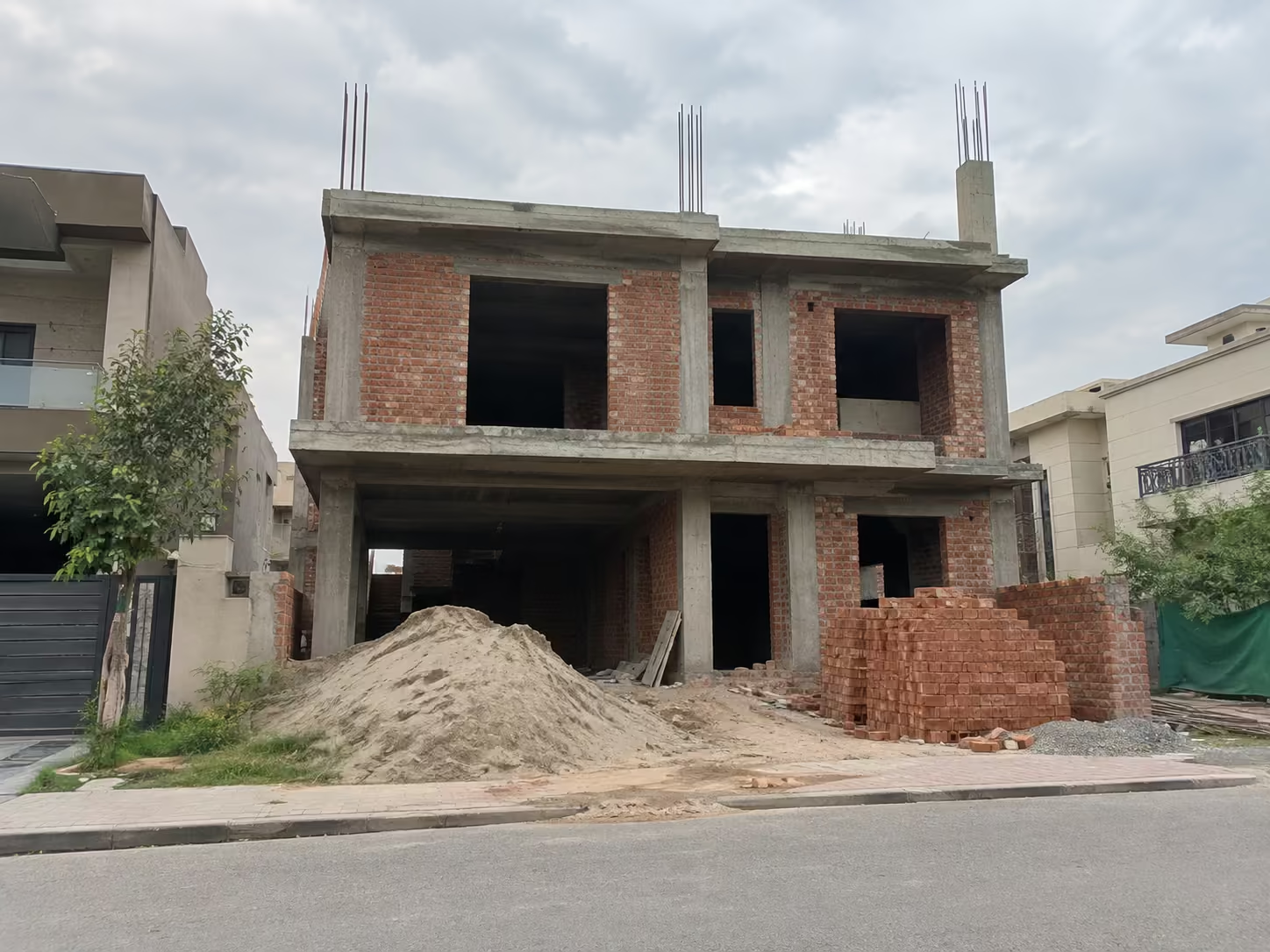
A freshly painted wall can hide a lot of what’s happening underneath it. The grey structure foundations, reinforced-concrete elements, masonry, slabs, beams, and columns establish the fundamental framework the rest of the house depends on. Understanding your house construction costs in Pakistan ensures that quality materials are used at this vital stage before plaster and paint cover up any flaws
Design Coordination Also Affects How a Building Performs
Construction quality starts before materials arrive on site. When architectural and structural drawings are properly coordinated, openings, walls, structural elements, and services are built as intended, reducing the ad hoc changes during construction that are a common, avoidable source of cracking at junctions and openings.
If the Crack Actually Needs Repair
Once the cause is understood, the repair should match the actual problem: surface plaster, masonry, concrete, moisture, material movement, settlement, or a damaged joint are all different situations with different fixes.
The principle is simple: repair the cause where one exists, not just the visible line.
If the issue is cosmetic and stable, a finishing repair is likely sufficient. If movement is ongoing, the underlying cause needs to be addressed first; otherwise, the repair is temporary at best.
Common Myths About Wall Cracks
Myth 1: Every crack means the foundation is failing.
Reality: Cracks have many possible causes, shrinkage, thermal movement, material junctions, settlement, and structural loading, among them. Foundation failure is one possible cause, not the default explanation.
Myth 2: Every hairline crack is harmless.
Reality: Not necessarily. A hairline crack’s significance depends on its location, pattern, progression, and any accompanying signs of movement, not its width alone.
Myth 3: Filling the crack permanently fixes it.
Reality: If the underlying movement continues, a filled crack can reappear. Understanding the cause first is what makes a repair durable.
Myth 4: Crack width is all that matters.
Reality: Width is one data point. Pattern, location, movement, structural involvement, and progression matter just as much.
Myth 5: New houses should never crack.
Reality: Some controlled cracking is a normal part of how construction materials behave as they dry, cure, and settle. The realistic goal of good construction is to manage and limit cracking, not to guarantee that none will ever appear.
When Should You Call a Professional?
Consider getting a professional opinion when:
- A crack is visibly widening
- You notice displacement on either side of it
- Several related cracks are appearing together
- Cracking involves a beam, column, slab, or foundation
- Doors or windows suddenly become difficult to operate
- There’s significant water penetration through the crack
- The crack follows a stair-step pattern through masonry
- You suspect foundation movement
- You genuinely can’t tell whether the crack is superficial or deeper
- A previously repaired crack has come back
The point of a professional assessment isn’t to alarm you; it’s to replace guesswork with an actual, on-site evaluation of your specific home.
Frequently Asked Questions
Are cracks in new houses normal?
Some minor cracking can occur as building materials shrink, expand, and dry over their early life, and this isn’t automatically a defect. Significant, widening, or structurally involved cracking, however, isn’t something to treat as routine.
Are hairline wall cracks dangerous?
Not necessarily. Fine surface cracks are often related to plaster or finish movement. Their significance depends on location, pattern, progression, and whether they extend into masonry or a structural element.
Can settlement cause cracks in walls?
Yes. Differential settlement, where different parts of the foundation or ground move unevenly, can produce masonry cracking, and stair-step cracking is one pattern sometimes associated with it. It isn’t the only possible cause of that pattern, though.
Should I fill a crack as soon as I see it?
Not if you don’t understand what’s causing it. If a crack is changing or its cause is unclear, document and monitor it first. Filling the surface without addressing ongoing movement often means the crack returns.
Why do cracks appear around windows and doors?
Openings interrupt an otherwise continuous wall, which concentrates stress around them. Proper detailing at openings helps manage this movement and reduce the likelihood of cracking there.
Can weather cause wall cracks?
Temperature and moisture changes contribute to material movement and can cause or worsen cracking, particularly in a climate with large seasonal swings. That said, weather shouldn’t be assumed to be the automatic explanation for any specific crack without looking at the fuller picture.
Do cracks always mean poor workmanship?
No. Some cracking reflects normal material behavior and environmental movement rather than a construction defect. That said, poor design, inadequate detailing, unsuitable materials, or workmanship can also cause avoidable cracking, which is exactly why the cause needs to be established rather than assumed either way.
Can a crack return after repair?
Yes, if the underlying movement or cause hasn’t actually stopped. Understanding the cause and whether the associated movement has stabilized before completing a permanent repair is what prevents this.
Final Takeaway
A crack in a new home isn’t automatically a disaster, but it’s also not something to blindly ignore. The smartest approach is to look at the whole picture rather than jump to a conclusion from the crack’s appearance alone.
A fine crack limited to plaster tells a very different story than a widening diagonal crack running through masonry. A small line near a window may relate to normal movement around an opening, while a stair-step pattern paired with other warning signs may call for a closer look at settlement.
For homeowners in Pakistan, sound design, appropriate foundation decisions, proper construction practices, and quality control at the grey-structure stage all play a role in how and whether a house cracks over time.
Don’t panic when you see a crack. Investigate it. And don’t cover it up just because it looks small; understand it first.
The most reliable approach: observe → document → assess → identify the cause → repair appropriately → monitor.
That’s how a homeowner moves from guessing about a crack to making a genuinely informed decision. If you’re unsure what a crack means for your property, OKK Construction can help you assess the situation and plan the right next step with confidence.