When you compare builders for a new house or villa, proposals usually come in one of two forms. The first is a set price for a defined scope of work. The second is the actual cost of construction plus a contractor fee.
Neither is automatically safer. A fixed-price construction contract in Pakistan is only as dependable as its scope. A cost-plus contract is only as dependable as its records and approval limits. The safer construction contract for a house in Islamabad is the one where scope, price basis, payments, and changes are written clearly enough that both sides would describe them the same way.
Key takeaways
- A fixed price covers a defined scope. Anything outside that scope, or any approved change, can still move the total.
- Cost-plus is not “unlimited spending.” Caps, approvals, and records can be written in.
- A per-square-foot rate is a pricing unit, not a complete contract.
- Payments work best when tied to verified progress, with written approval for extra work.
- Your signed agreement, not a general rule, decides who bears a cost increase.
This article is general information, not legal advice. Contract practice varies between projects, so ask a qualified lawyer about your specific agreement.
What Is a Fixed-Price Construction Contract?
In a fixed-price (or lump-sum) contract, you and the contractor agree on one price for a defined scope of work. Within that scope, the contractor generally carries the risk of ordinary cost movements, to the extent the contract says so.
What the price actually covers
“Fixed” refers to the price of what is defined. A well-prepared agreement identifies:
- Drawings and specifications the price is based on
- Inclusions, meaning what is part of the price
- Exclusions, meaning what is not (for example, boundary wall, landscaping or specific fixtures)
- Assumptions, such as site access, soil conditions, or approvals being in place
Where finishes are not yet chosen, contracts often use an allowance (also called a provisional sum), a placeholder amount for an item you’ll select later. If your final choice costs more or less than the allowance, the price is adjusted. Check whether the contract says so.
Advantages and limitations
Advantages
- A clearer budget at the start, if the scope is complete
- Less day-to-day involvement in purchasing
- Easier like-for-like comparison between proposals
Limitations
- Vague scope creates disputes about what was “included”
- The price may include a contractor’s allowance for risk, or exclude price escalation altogether
- Changes after signing normally adjust the price
- It suits projects with reasonably complete drawings and specifications
A fixed price does not eliminate every extra cost. Excluded items, approved changes, and conditions the contract assigns to the homeowner can all still change the final total.
Is a per-square-foot rate a fixed price?
Many homeowners are quoted a rate per square foot. A rate is a unit of pricing, not a complete agreement. Before treating it as a fixed price, clarify:
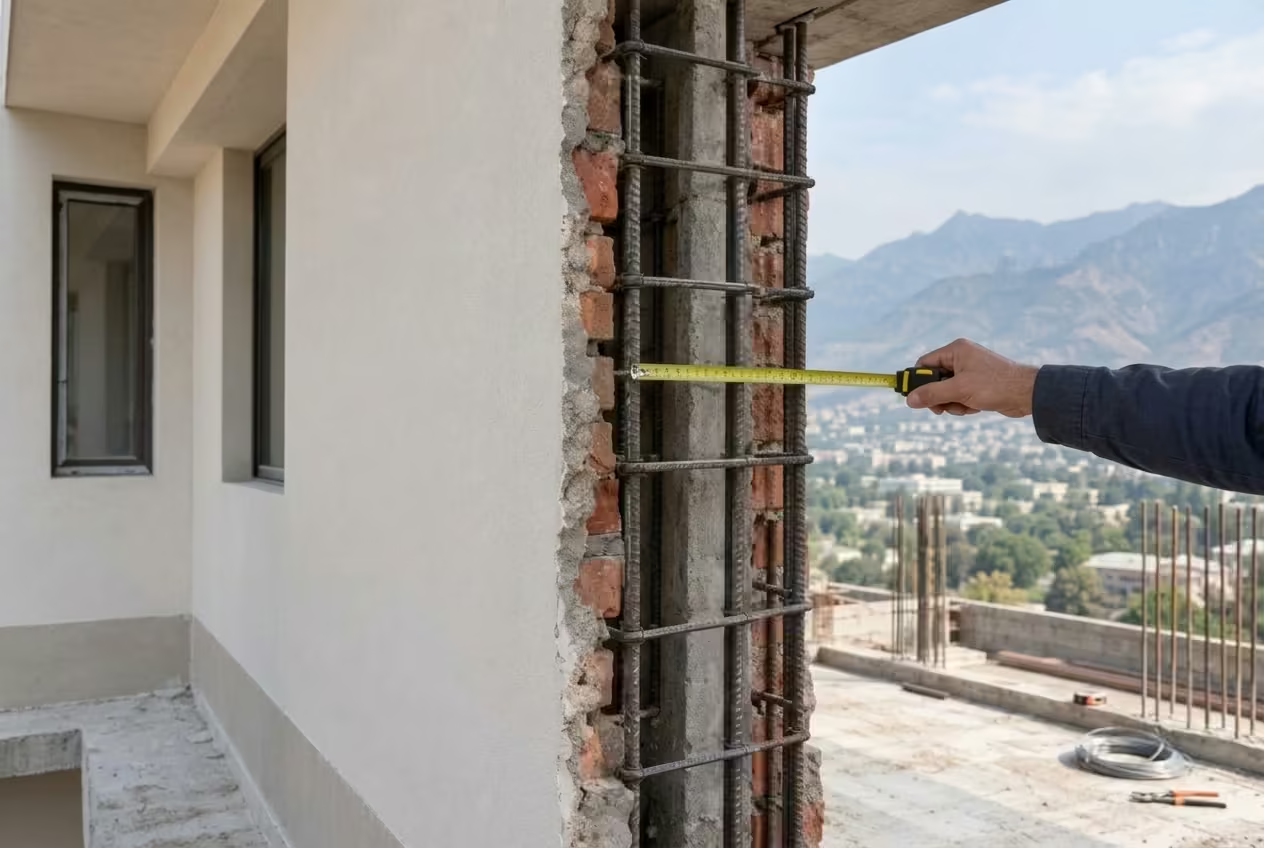
- Which area is counted. Covered area, basement, terraces, porches, and boundary walls may be treated differently.
- How area is measured, from approved drawings or re-measured on site.
- What the rate includes, such as material grades and specifications.
- What happens to the total if the built area changes.
Two proposals with the same rate can produce very different totals once these points are settled. If you’re comparing quotes, a bill of quantities (BOQ) can make the scope visible. This guide focuses on the contract rather than the quantities themselves.
What Is a Cost-Plus Construction Contract?
In a cost-plus construction contract, you reimburse the contractor’s eligible construction costs and pay a fee on top. The contract should state exactly what counts as eligible.
A well-drafted cost-plus agreement defines:
- Reimbursable costs (typically materials, labour and equipment) and which overheads are covered by the fee instead
- Supporting records, such as invoices, receipts and periodic cost statements
- The fee, as a fixed amount or a percentage, as agreed
- Approval procedures for major purchases, subcontractors and substitutions
- Any estimate or ceiling, and what happens when spending approaches it
How the fee changes the incentives
This is a hypothetical example for arithmetic only, not a market rate or a quote. Suppose eligible costs are Rs. 10,000,000 and the fee is 10%, which gives Rs. 1,000,000. If costs rise to Rs. 12,000,000, a percentage fee rises to Rs. 1,200,000, while a fixed fee stays at Rs. 1,000,000. Because a percentage fee grows with spending, some homeowners prefer a fixed fee or a cap. Others accept a percentage if records and approvals are strong. The right choice depends on the agreement as a whole.
Controlling a cost-plus budget
Cost-plus does not mean uncontrolled spending. Common controls include:
- An estimated budget with regular cost-to-date reports
- A cost cap (sometimes called a guaranteed maximum price), meaning an agreed upper limit above which the contractor bears extra costs, if the contract is drafted that way
- Written approval for purchases above an agreed amount
Advantages: flexibility while the design develops, cost transparency, and no risk allowance built into an upfront price for unknowns.
Limitations: the final cost is less predictable at the start, it needs more homeowner involvement, and it depends heavily on record quality. Cost-plus is not automatically more expensive than fixed-price. The outcome depends on how each is structured and managed.
Fixed-Price vs Cost-Plus: What Is the Difference?
| Factor | Fixed-Price | Cost-Plus |
| How price is determined | Agreed price for a defined scope | Eligible actual costs plus an agreed fee |
| Budget predictability | Higher at the start, if scope is complete | Lower at the start; depends on estimate, cap and controls |
| Cost increases | Allocation depends on the contract; often the contractor’s risk within scope | Often reimbursable, unless a cap applies |
| Documentation and reporting | Less cost reporting; detailed scope is essential | Detailed cost records and reports are essential |
| Design changes | Priced through written variations | Flow-through costs; approval steps still advisable |
| Client involvement | Heavier before signing, lighter during construction | Heavier throughout |
| Suitable circumstances | Complete drawings and specifications | Evolving design or uncertain scope |
| Risks to clarify before signing | Exclusions, assumptions, variation pricing | Eligible costs, fee basis, approval limits, cap |
Hybrid arrangements
Real agreements are often mixed. Examples include a fixed price with allowances for undecided finishes, cost-plus with a cap, or a fixed price for structural work with a different basis for finishing. Hybrids can work well, but they need especially clear drafting about which part follows which rule.
Planning to build a house in Islamabad or Rawalpindi? Discuss your project scope and construction requirements with OKK Construction before finalizing your agreement. Request a Construction Consultation
Who Bears the Risk When Construction Costs Change?
There is no automatic answer. The signed contract, its exclusions, and applicable law decide who pays. Prices of materials and labour can move during a project, so these points should be settled in writing before work starts.
| Risk | Questions to settle in writing | Options an agreement may use |
| Material prices | Is the price held for the whole project? Which materials, if any, are adjusted? | Fixed for the term; or an agreed adjustment method for named materials |
| Labour costs | Included in the price, or reimbursed as incurred? | Included (fixed-price) or reimbursed with records (cost-plus) |
| Homeowner changes | Who prices the change, and when is it approved? | Written variation before work proceeds |
| Unforeseen site conditions | What soil or site assumptions underlie the price? Who pays if they differ? | Stated assumptions; a procedure for notifying and pricing differences |
| Delays | What events justify an extension? Are there consequences for delay? | Defined grounds for extension of time; agreed delay provisions |
| Specification changes | Who approves substitutes if a material is unavailable? Who pays any difference? | Written approval of alternatives and price effect |
Silence in a contract is a risk in itself. If a clause is unclear, ask for it to be clarified rather than assuming how it would be read.

How Should Construction Payments Be Structured?
Construction payment terms for house construction depend on the project and the agreement. There is no universal deposit percentage or standard schedule in Islamabad, so be cautious of anyone presenting one as a rule. Common elements include:
- An initial payment, where agreed, with its purpose stated (for example, mobilisation or early procurement)
- Payments linked to verified progress, such as completed stages, rather than only to dates
- Supporting invoices and records, especially under cost-plus
- Written approval before additional work is performed and billed
- Retention or final-payment arrangements, if negotiated
A sample structure (illustrative, no percentages)
A progress-based schedule might link payments to stages such as foundation completion, ground-floor slab, upper-floor slab, masonry, services rough-in, finishing,g and handover. For each stage, the contract should say what “complete” means, who verifies it, and how the amount is calculated. This sample is for understanding only, and your schedule should reflect your project.
Retention explained
Retention is a portion of the payment held back until a later point, usually handover or the end of a defect-rectification period, so that unfinished or defective items can be addressed. It is negotiated, not mandatory, so only include it if both parties agree and the terms are written down.
Keep a record of every payment: amount, date, method, and what it relates to. If a payment is requested ahead of a defined milestone, ask what it covers and have the answer recorded.
What Happens When the Homeowner Changes the Design?
Changes are normal. What matters is that they are recorded before the work is done. A variation (or change order) is a written record of an agreed change.
Illustrative example (not a quotation or legal ruling). After masonry has started, a homeowner decides to enlarge a bedroom window and shift a partition wall. A written variation might record:
| Field | What to record |
| Requested change | Enlarged window and relocated partition, with revised drawing reference |
| Revised scope and specification | New window size and frame material; any structural or finishing work affected |
| Price adjustment | Amount added, reduced, or estimated (Rs. [amount]) and how it was calculated |
| Effect on timeline | Whether the schedule changes and by how much |
| Approval | Signatures or written confirmation from the relevant parties before work begins |
Without this, a verbal “move it slightly” can turn into a disagreement about cost and time later. The same process applies under both contract types.
Which Contract Structure May Suit Grey Structure Construction?
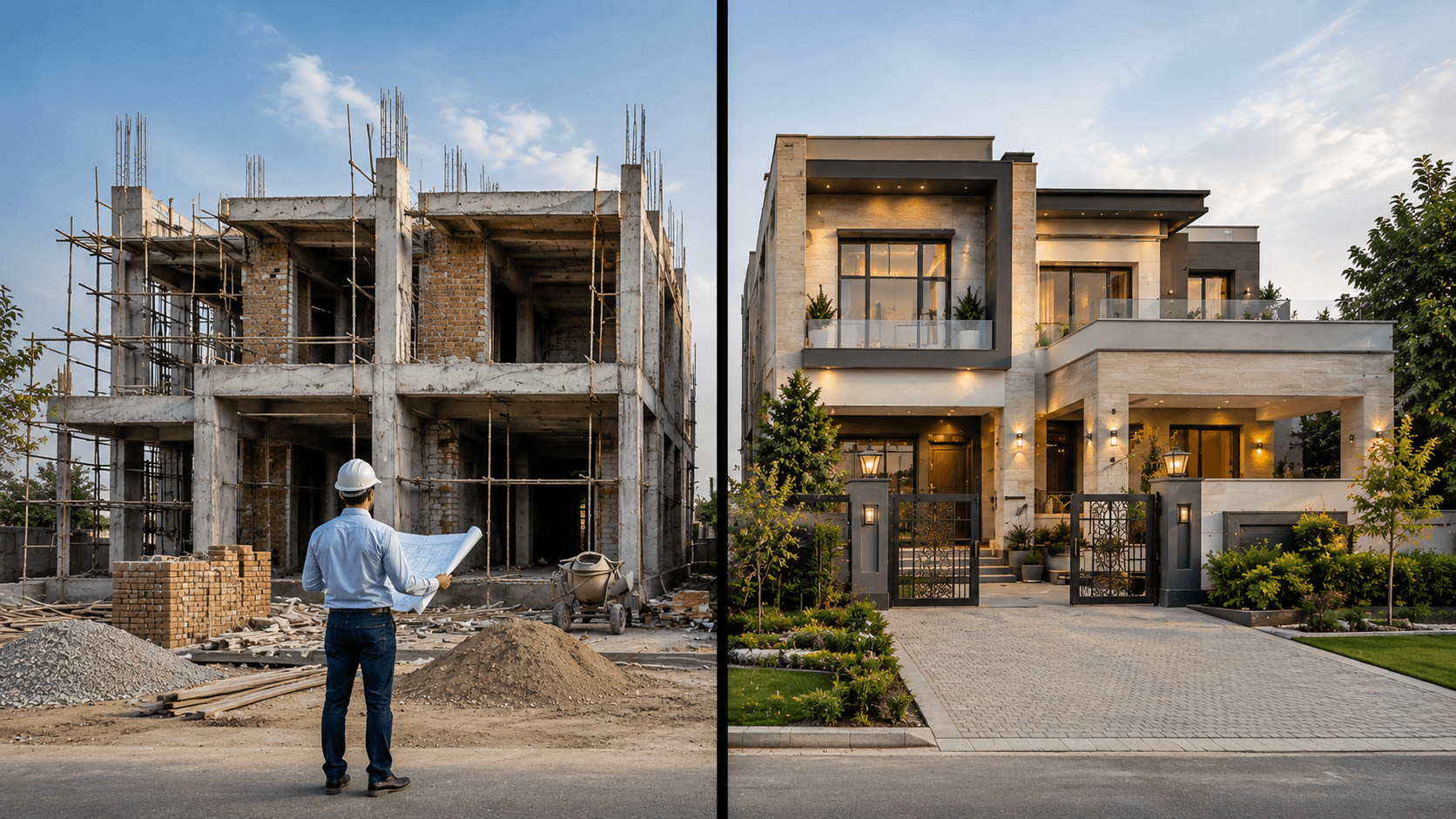
Grey structure construction covers the structural shell of the house. Much of this work is measurable and drawing-based, so either structure can be workable. Clarity matters more than the label. Define:
- Structural work included, such as foundation, columns, slabs,bs and masonry
- Materials and quality requirements
- Drawings and structural details relied on
- Exclusions, such as finishing, fixtures, and external works
- Responsibility for changes, including who approves them and how they’re priced
A fixed price may suit a project with complete structural drawings. Cost-plus, or a cap, may be considered where details are still being finalised. Neither is always best.
Which Contract Structure May Suit Turnkey Construction?
Turnkey construction includes finishing, so it involves many more choices: flooring, tiles, kitchens, bathrooms, electrical and plumbing specifications, doors, windows and fixtures. This is where unclear scope most often leads to misunderstandings.
Consider documenting:
- The specification of major finishing items (grade, size or brand, where relevant)
- Allowances for items not yet selected, and how differences are settled
- Electrical and plumbing specifications, including points, fittings and layout
- Who selects and approves finishes, and by when
- How changes are priced and approved
A fully specified home may suit a fixed price. One with many undecided selections may suit allowances or cost-plus. Either way, a detailed scope and a documented change process reduce misunderstandings.
What Should Homeowners Review Before Signing a Construction Contract?
Construction contract terms and conditions in Pakistan vary, so use this as a general review checklist, not a substitute for legal advice.
| Item | What to look for |
| Parties and responsibilities | Full names and addresses; who handles permits, approvals, and site access |
| Scope of work | A clear description of what will be built |
| Drawings and specifications | Listed by reference and attached or clearly identified |
| Inclusions and exclusions | Stated explicitly, not implied |
| Pricing method and fee | Fixed price, rate basis, or cost-plus with fee calculation and any cap |
| Payment schedule | Triggers, amounts, verification, and retention if agreed |
| Material and workmanship requirements | Standards, approval of samples, and rules for substitutions |
| Change-order process | Written, priced, and approved before work |
| Timeline and delays | Start and completion dates; grounds for extension; delay provisions |
| Inspection, handover and defects | Who inspects, when handover occurs, how defects are reported and fixed |
| Dispute resolution | The agreed procedure for disagreements |
| Termination | How either party can end the agreement, and what happens to payments and completed work |
| Signatures and documents | Signed copies for both parties, with all annexures attached |
A qualified lawyer can advise on how clauses may be read under applicable law, including questions such as formalities for signing the agreement.
Which Option Is Safer for Your House Construction Project?
Safety comes from clarity, a realistic scope, transparent records and clear procedures, alongside the pricing model. This framework can help you decide what to resolve first.
| If your situation is… | Consider… | Because… |
| Drawings and specifications are complete | A fixed price, with clear exclusions | The scope can be defined well enough to price |
| Design or finishes are still developing | Cost-plus, allowances, or a hybrid | Pricing everything upfront would rely on guesses |
| Your budget is tight | A fixed price, or cost-plus with a cap | You’ll want predictability or a ceiling |
| You can review records regularly | Cost-plus becomes more practical | It depends on active oversight |
| You expect to make changes | Either, with a strict variation process | Changes affect both types |
Questions to ask any contractor
- What exactly is included in this price, and what is excluded?
- How are changes priced and approved?
- If material prices move, what does the agreement say?
- How will progress be verified before each payment?
- (Cost-plus) Which costs are reimbursable, and what records will I receive?
- What happens if there are delays, or if either of us wants to end the agreement?
A contractor who answers these clearly and puts the answers in writing is giving you useful information, whichever pricing method is used.
Discuss Your Construction Contract Requirements With OKK Construction
If you’re planning a house or villa in Islamabad or Rawalpindi, it helps to talk through your scope before you finalise an agreement. When you get in touch, it’s useful to share:
- Your drawings, if you have them
- Your current stage (planning, grey structure, finishing)
- The finishes and specifications you’ve already decided
- Your preferred payment arrangement
You can request a quote or ask for a consultation to discuss your project requirements. For related services, see our pages on villa construction and luxury home construction.

FAQs
1. What is the difference between a fixed-price and cost-plus construction contract?
A fixed-price contract sets one price for a defined scope. A cost-plus contract reimburses eligible, documented costs and adds a fee. The first emphasises predictability, the second flexibility and transparency.
2. Is a fixed-price contract guaranteed to cover every expense?
No. It covers the defined scope. Exclusions, approved variations, and risks the contract assigns to the homeowner can still change the total.
3. How does a contractor calculate a cost-plus fee?
It depends on the agreement. The fee is usually a fixed amount or a percentage of eligible costs. A percentage rises with spending, so many agreements add a cap or approval limits.
4. Can the price change after a construction contract is signed?
Yes, if the contract allows it, for example through approved variations, allowance adjustments, or agreed price-adjustment terms. Each change should be documented and approved in writing.
5. How should homeowners approve extra work?
In writing, before the work starts. The approval should record the change, the revised scope, the price effect, the timeline effect, and who approved it.
6. What should a house construction payment schedule include?
Payment triggers, amounts, how progress is verified, supporting records, any retention, and the condition for final payment. The structure should reflect the project and what both parties agree.
7. Is a per-square-foot rate the same as a fixed price?
Not necessarily. A rate is a pricing unit. Check which area is counted, how it is measured, what the rate includes, and what happens if the area changes.
8. Which contract structure may suit grey structure or turnkey construction?
Either may be workable. What matters is a defined scope. Grey structure work with complete drawings may suit a fixed price, while turnkey projects with undecided finishes may suit allowances or cost-plus.
9. Should a homeowner have a construction contract reviewed by a lawyer?
It is advisable, especially for larger projects or unclear clauses. A lawyer can explain how terms may be interpreted and advise on formalities.
10. What documents should homeowners review before signing?
The contract, drawings, specification sheets, the inclusions and exclusions list, the payment schedule, the timeline, and any annexures. Everything the price relies on should be attached or clearly identified.